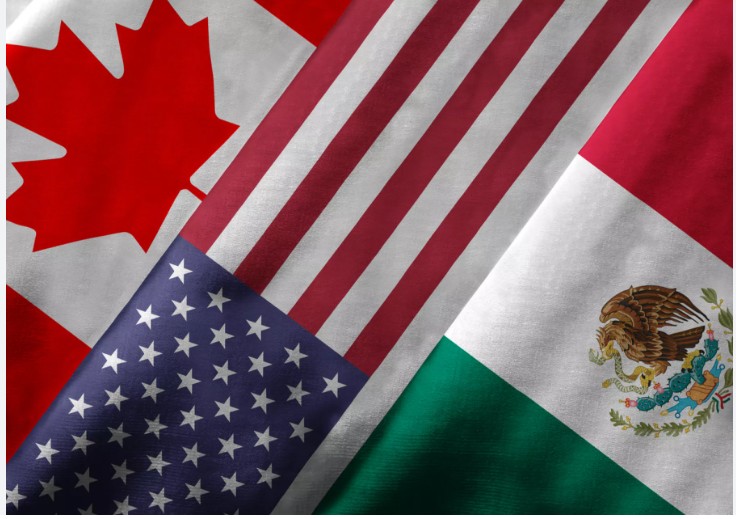
U.S. President Donald Trump stated that he is considering allowing the United States–Mexico–Canada Agreement (USMCA) to lapse in order to pursue a new trade deal. The proposal introduces uncertainty for North American trade dynamics and could trigger adjustments across supply chains in the region.
USMCA was negotiated during Trump’s first term and took effect in July 2020, replacing the North American Free Trade Agreement (NAFTA), in place since 1994.
“It’s already underway. It expires in about a year, and we may let it expire or negotiate a new deal with Mexico and Canada,” Trump said during a press briefing.
The president argued that Mexico and Canada have benefited more from the current agreement and emphasized that tariffs have helped incentivize the return of automotive manufacturing to the United States.
Trump has voiced criticism of USMCA on previous occasions. On July 1, he referred to the pact as a “disaster” and suggested seeking congressional backing to terminate it. He also recently mentioned that bilateral agreements could serve as an alternative.
A formal review of USMCA is scheduled for July 2026. In preparation, Mexico’s Ministry of Economy conducted consultations in October with representatives from 30 industries and stakeholders across all 32 federal states.
The agreement has a 16-year lifespan, and under Article 34.7, a review is required six years after implementation to assess its performance and decide on its renewal for another 16 years.
Analysts note that changes to the treaty could impact trade flows, particularly for sectors currently benefiting from zero tariffs under USMCA. More than 80% of Mexico’s exports to the United States fall under this category.
According to U.S. Commerce Department data through August 2025, Mexico remains the United States’ top trading partner, with a total exchange of $74.396 billion, followed by Canada at $56.590 billion and China at $33.405 billion. Mexican exports to the U.S. totaled $45.146 billion during the same month, showing a 3.3% increase year-over-year.
Source: T21